1-2 T/H FISH FEED PELLET mill
Customized 1-2 ton per hour fish feed factory turnkey project for sale, including fish feed factory process design, fish feed production plan design, and a full set of fish feed production equipment.
What is 1-2 t/h fish feed pellet mill?

The 1–2 ton/hour fish feed pellet mill is
a solution that comprehensively plans all production stages while ensuring a stable output of 1–2 tons per hour.
By properly matching processes like grinding, mixing, pelletizing, and cooling, the entire line operates more stably, making production easier to manage. The final pellets have a uniform appearance with minimal quality fluctuation.
Production capacity
(tons/hour)
1-2
Pellet size
(mm)
0.5-12
What are its key features?
Stable Capacity, Ideal for Continuous Production
This capacity range has moved beyond the intermittent production model of small-scale equipment. It can run continuously for long periods, steadily producing 1-2 tons of feed per hour. This covers daily production needs without creating unnecessary investment pressure from overly large capacity.
High System Integration, Smoother Operation
Every stage, from grinding and mixing to pelletizing, cooling, and sieving, is configured for this specific output. Equipment connects seamlessly, material flows smoothly, reducing blockages and downtime. Less need for frequent adjustments makes the process more worry-free.
More Consistent Pellet Quality
A steady production rhythm with fewer parameter changes results in feed pellets that are more uniform in size, density, and appearance. Quality fluctuations are minimal, making it easier to meet customer or market requirements.
Proven Solution, Easier to Use
The 1-2 ton/hour range is a highly mature capacity. The equipment and processes have been validated in numerous real-world projects. Installation and commissioning are relatively simple, operation and maintenance are easier to learn, resulting in lower overall risk.
Lower Investment Pressure, Cost-Effective
Compared to large-scale feed plants, these lines have more flexible requirements for factory space, power, and supporting facilities. The overall investment is more controllable, making them ideal for first-time setups or transitioning from small-scale to standardized production.
Easy Future Expansion
Existing configurations can often accommodate future expansion. This meets current needs while leaving room to scale up operations later.

Who is the 1–2 Ton/Hour Fish Feed Pellet mill Best For?
A 1–2 ton/hour fish feed pellet mill is primarily suitable for user groups that have established production needs but do not want to make a large one-time investment. Typical examples include the following categories:


Do you already have a stable farming operation?
If your fish ponds or farm consistently use a steady amount of feed, and you want to control your own formulas and costs instead of relying on purchasing feed each time, then a 1–2 ton/hour capacity can cover your daily needs without leaving equipment underutilized.
Are you planning to transition from contract manufacturing to self-production?
Many clients start by outsourcing production to test the market. Once orders stabilize, they consider building their own plant. A 1–2 ton/hour setup is a relatively low-risk, manageable starting point with reasonable investment pressure.
Are your customers mainly local or in nearby regions?
If you’re not aiming for a massive market initially but rather serving one city or surrounding areas, focusing on reliable supply and fast turnover, this capacity range is ideal. It avoids the waste associated with overly large capacity.
Do you frequently need to change formulas or product types?
Users who switch between different fish species or feed specifications are well-suited for a 1–2 ton/hour line. It’s easy to adjust, has low switching costs, and is particularly good for long-term production involving multiple formulas and small batches.
Is this your first time investing in a feed plant?
If you’re new to feed processing, wanting professional, stable equipment without a huge initial investment, a 1–2 ton/hour fish feed pellet plant is a relatively safe and practical choice. It also leaves room for future expansion.
What Feeds Can a 1–2 T/h Fish Feed Plant mill?
A 1–2 ton/hour fish feed pellet mill falls into the medium-capacity range and can accommodate the production of various types of aquatic feeds and some pet foods. Depending on the process configuration, it can stably produce the following common feed types:

Floating Fish Feed
Floating pellets are currently the fastest-growing market segment. Using advanced extrusion technology, high-fat fish feed pellets can be produced, which stay suspended in water for longer periods.
Target species: Tilapia, carp, catfish, ornamental fish, etc.
Pelletizer type: Extruders (dry type extruder, wet type extruder, twin screw extruder)

Sinking Fish Feed
Conventional sinking fish feed is usually produced using pelletizing technology. However, with advancements in feed production technology, fish feed plants now also use extrusion to produce sinking fish feed, overcoming the shortcomings of traditional pelletized sinking feed.
Target species: Sturgeon, grouper, marine fish, shrimp
Pelletizer type: Pellet mill, extruder

Slow-Sinking Feed
There is also considerable market demand for slow-sinking fish feed, which consists of pellets that fall between floating and sinking types, suitable for mid-to-bottom-feeding species.
Target species: Catfish, yellow catfish, snakehead fish, seabass, turbot
Pelletizer type: Single/Twin screw extruder

Custom Aquatic & Pet Feeds
A 1–2 ton/hour fish feed pellet mill isn’t limited to just fish feed; it’s a versatile production line capable of handling fish feed, shrimp feed, and even pet food.
Types: Shrimp, crab feed, specialty aquatic feed, mid-to-high-end pet food
Pelletizer type: Extruders, often twin screw extruders

Overall Process Flow of a 1-2 Ton/Hour
Fish Feed Pellet mill
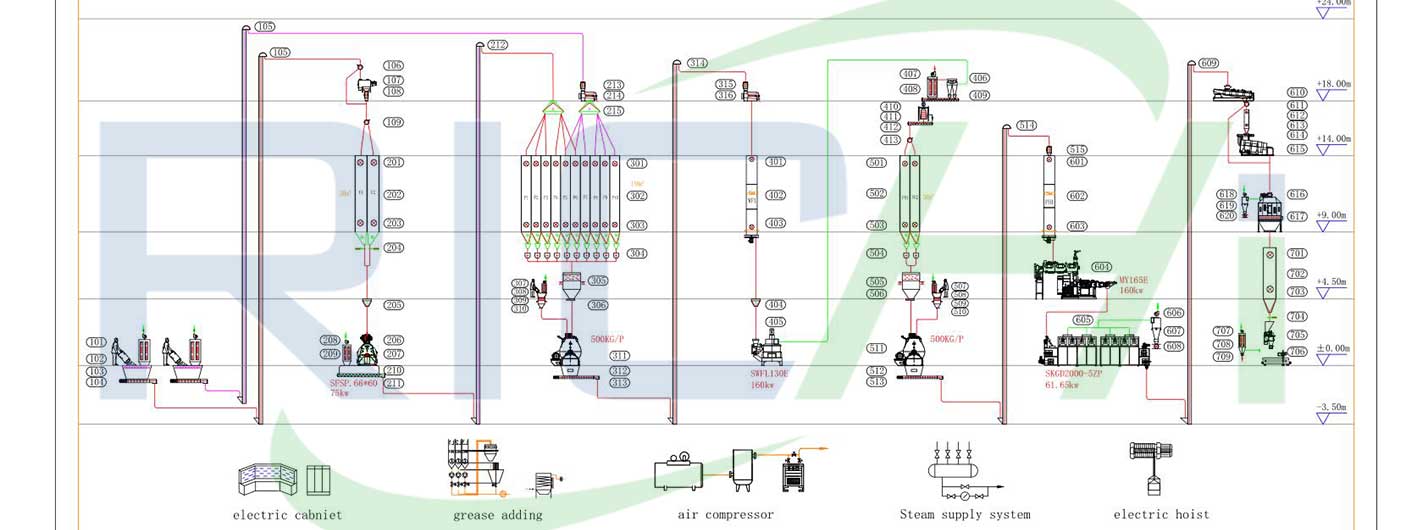
A 1-2 ton/hour fish feed pellet mill line consists of multiple basic stages, from raw material intake to final product packaging, with each step having a clear division of labor.
Here is the typical production process we designed for a 1-2 ton/hour fish feed production line:
●
Raw material processing
Raw materials first undergo cleaning, impurity removal, and weighing. This ensures that the materials entering the production line are clean, consistent, and free of contaminants, laying a solid foundation for subsequent grinding and formula control.
●
Crushing of raw materials
A grinder processes materials like corn, soybean meal, and fishmeal down to the required fineness. The more uniform the grind, the better the stability of the feed’s floatability, binding properties, and digestibility.
●
Automatic batching and mixing
All ingredients are thoroughly mixed according to the formula ratio. This critical step ensures every batch has uniform nutrition and no separation, guaranteeing feed quality.
●
Pelleting/Extrusion
Pellet formation takes place in a pellet mill or an extruder. An extruder can also control the expansion level, density, and floating/sinking properties, which determine the final quality of the product.
●
Drying
Freshly made wet pellets are quickly and evenly dried to reduce their moisture content to a safe level, preventing mold and extending shelf life.
●
Spraying
Sensitive nutrients like fats, probiotics, and attractants are added evenly at low temperatures. This enhances the energy value, palatability, and market appeal of the product.
●
Cooling & Screening
Hot pellets are cooled to set their shape. At the same time, powder and broken pellets are sifted out, ensuring the finished pellets have a uniform size, a cleaner appearance, and greater stability for packaging.
●
Packaging
The line automatically weighs, bags (typically in 50kg or larger sizes), and seals the final products, creating packaged feed ready for sale.
Main equipment used in A 1-2 t/h fish feed
pellet mill
A complete feed production line requires many pieces of equipment, including main machines like grinders, mixers, extruders, and belt dryers, as well as many auxiliary devices such as conveyors, silos, and cleaning equipment.
RICHI can provide all the necessary feed production equipment, and we manufacture these machines ourselves. With a production workshop of over 60,000 square meters, modern manufacturing facilities, and a professional team, we can guarantee the quality of every piece of feed machinery.
Our factory welcomes every customer to visit at any time. We also invite you to come to our company to discuss your ideas.


Pelleting Solution vs. Extrusion Solution:
Which is More Suitable for
a 1–2 Ton Capacity?
In the capacity range of 1–2 tons per hour, both pelleting and extrusion solutions are viable, but they have different focuses and are suitable for different types of users. Therefore, there is no absolute “better” solution.
If you prioritize stable output, cost control, and mainly produce sinking feed, then choosing a pelleting solution is very appropriate.
However, if your focus is on producing floating feed or mid-to-high-end aquatic feed, and you can accept a relatively higher investment, then an extrusion solution will have more advantages.

Pelleting Solution: more stable, more cost-effective, better for sinking feed
The core equipment is a ring die pellet mill, emphasizing continuous and stable operation with controllable overall investment. It is particularly suitable for production needs centered on sinking fish feed and conventional aquatic feed.
At this capacity level, the pelleting process is mature, energy consumption is low, and the equipment structure is relatively simple. The long-term costs and maintenance pressure are small, making it easier to achieve stable production and quicker return on investment.

Extrusion Solution: more flexible, suitable for floating and high-value-added feed
It pays more attention to the degree of feed cooking and finished product shape control. It is suitable for producing floating fish feed or products that require higher requirements for pellet density and water stability.
At a capacity of 1–2 tons/hour, the extrusion system can adapt to more diverse formulas, and the produced feed has a better appearance. However, the corresponding equipment investment, energy consumption, and operational difficulty are higher. It is more suitable for users with clear product positioning who want to earn higher profits through differentiated feed.
Six Major Plant Types: Which 1–2 T/H feed Pellet mill to Choose?

1-2 Ton/Hr Fish Feed Pellet Mill
A medium-capacity line that can stably produce floating, sinking, and various other types of aquatic feed.
It features a mature, highly adaptable process, suitable for factories with multiple formulas or those serving various farmed species.
Can be configured with single-screw, wet, or twin-screw extrusion systems to meet different density and quality requirements.

1-2 Ton/Hr Floating Fish Feed Pellet Mill
This production line specializes in high-expansion, strongly-floating fish feed pellets, often used for markets like tilapia, grass carp, carp, and perch.
Its core equipment is an extruder, which allows for stable control of cooking level, pellet density, and expansion rate.
It’s ideal for clients looking to create brand-oriented, differentiated floating feeds.

1-2 Ton/Hr Sinking Fish Feed Pellet Mill
Meets the production needs for conventional or premium sinking fish feed, offering a choice between a ring die pellet mill or an extruder.
Ring die is suitable for high-volume, cost-sensitive products; extrusion is better for high-protein, high-fat, and more palatable formulas.
The entire line can support the large-scale production of sinking feed for species like tilapia, catfish, blunt-snout bream, and marine fish.

1-2 Ton/Hr Shrimp Feed Pellet Mill
Specialized in producing high-density, water-stable shrimp feed pellets (semi-floating or sinking).
The line typically includes a twin-screw extruder or a ring die pellet mill, allowing for precise control over pellet hardness, shape, and micro-level size.
It’s designed for the shrimp farming market, including species like Pacific white leg shrimp, giant freshwater prawn, and tiger shrimp.

1-2 Ton/Hr Pet Food Pellet Pellet Mill
Used for producing pet food pellets like dog and cat food.
It comes equipped with a twin-screw extruder, a precision coating system, and controlled drying/aging processes to meet the demands for high-fat, high-palatability, and high-expansion products.
It can manufacture various types of pet food, such as complete diets, grain-free kibble, high-protein foods, and puffed snacks, making it a mainstream capacity for entering the pet food market.

1-2 Ton/Hr Multi-functional Feed Pellet Mill
This is a hybrid production line compatible with both aquatic and livestock/poultry feed.
It’s suitable for the large-scale production of aquatic feeds (for fish, shrimp, crab) as well as common animal pellets (for chicken, duck, goose, cattle, sheep).
The line uses a modular design: the aquatic feed section can use an extruder, while the livestock/poultry section uses a ring die pellet mill. This setup allows for switching between different product lines based on orders.
What capacity fish feed plants have we built?
In our 30 years of building feed plant projects, RICHI has constructed numerous feed mills and pellet production plants in over 140 countries worldwide.

Uzbekistan: 1 Ton/Hr Floaing Fish Feed & Animal Feed Factory
Capacity: 1 t/h
Country: Uzbekistan
The factory can produce floating fish feed, as well as feed for chickens, cattle, and sheep.

Russia: 5 Ton/Hr Floating Fish Feed Plant
Capacity: 5 t/h
Country: Russia
It mainly produces fish feed pellets using advanced extrusion technology for high-end aquatic feed.

Indonesia: 5 Ton/Hr Floating & Sinking Fish Feed Plant
Capacity: 5 t/h
Country: Indonesia
This plant focuses on producing floating and sinking fish feed pellets and is equipped with an extruder to create 1-7mm fish feed pellets.

Malaysia: 3 Ton/Hr Fish & Shrimp Feed Factory
Capacity: 3 t/h
Country: Malaysia
It uses pelletizing technology to produce both fish and shrimp feed pellets. The pellet mill is equipped with a three-layer conditioner.

US: 1.5-2 Ton/Hr Fish Feed & Pet Food Mill
Capacity: 1.5-2 t/h
Country: the Us
The line is used to produce both fish feed and pet food pellets, maximizing the efficiency and profitability of the plant.

Norway: 10 Ton/Hr Salmon & Trout Feed Production Line
Capacity: 10 t/h
Country: Norway
This plant is dedicated to producing high-end salmon and trout feed pellets in 3-6mm.
What Factors Should Be Considered When Investing in and Building a 1–2 T/H Fish Feed Pellet mill?
First, you need to clarify what kind of feed you will mainly produce.
Will it be primarily sinking fish feed, floating feed, or do you plan to produce shrimp feed and other aquatic feeds in the future?
Different product types determine whether you choose a pelleting solution or an extrusion solution, which also directly affects equipment configuration, energy consumption levels, and overall investment scale. If the direction is not clear at the beginning, the cost of modifying the production line later will increase significantly.
Second, capacity should match real demand.
Although 1–2 tons per hour seems like a range, for many users, there are significant differences between 1 ton and 2 tons in terms of electricity usage, equipment specifications, and investment.
You need to consider your daily feed consumption, order stability, and future growth expectations to avoid starting with excessively high capacity, leading to low equipment utilization.
Third, factory conditions and basic supporting facilities must be confirmed in advance.
This capacity level has basic requirements for factory area, height, power capacity, and storage for raw materials and finished products.
If factory conditions do not match the equipment plan, installation may be restricted, processes may run poorly, or repeated modifications may be needed, increasing overall costs.
Fourth, don’t just look at equipment prices; calculate long-term costs.
Many users focus only on equipment quotes initially but overlook later expenses such as electricity, labor, wearing parts, and maintenance.
The difference in long-term operational costs between different process solutions is often more important than one-time equipment investment.
Fifth, consider whether operation and maintenance suit your capabilities.
A 1–2 ton/hour fish feed plant usually won’t have many professional technicians, so ease of use, stability, and after-sales support are crucial.
Choosing mature, easy-to-use solutions can significantly reduce operational risks.
Sixth, leave some room for future development.
Whether it’s expanding capacity, upgrading automation, adding packaging systems, or introducing new product types, whether the initial design allows for expansion will affect your flexibility.
A well-designed production line should meet current needs without limiting future options.

Investment & Operating Cost Analysis for a 1–2 T/H Fish Feed Pellet mill
Where does the upfront investment go?
- Equipment is the largest part, including crushing, mixing, pelleting/extrusion, cooling, screening, and conveying. The pelleting solution has simpler configuration with controllable investment, while extrusion requires more complex equipment and higher power, increasing the budget.
- Factory renovation, power expansion, foundation, and channel planning are also essential. Better alignment reduces later modification costs.
- Installation, commissioning, training, electrical systems, and safety facilities are necessary. They directly affect smooth startup and stable operation.
What are the main operating costs?
- Electricity is the most obvious and consistent expense. Pelleting lines have lower energy consumption, suitable for long continuous operation, while extrusion lines, with higher power, incur greater electricity costs.
- At 1–2 tons/hour capacity, labor costs are relatively controllable, usually requiring only a small staff. Higher automation reduces labor dependence but increases initial investment.
- Wearing parts like dies, hammers, rollers, etc., are daily consumables needing regular replacement. A mature process line with well-matched equipment has lower maintenance frequency, making it easier to control running costs.
What truly determines cost levels?
- First, ensure planned capacity is fully utilized. Idle capacity, even with low equipment prices, isn’t economical.
- Matching the process solution to target feed type directly impacts efficiency and costs. A suitable process reduces energy use and commissioning expenses, while a mismatch increases extra investment.
- Production stability and downtime frequency continuously affect costs. Stable operation makes it easier to control labor, electricity, and maintenance expenses.
- Whether repeated modifications or additional investments are needed later also significantly influences costs. Proper initial planning minimizes adjustments, making overall investment and operating costs easier to manage.

Expense Inventory
Grasp the key points of plant construction costs:
Upfront Investment
operating costs
factor for deciding costs
Can’t Find Fish Feed Plant You Want?
Contact Us To Customize For You

Why Choose a Professional Manufacturer to Build a 1–2 T/H Fish Feed Pellet mill?

When building such a plant, you may wonder about equipment choice, capacity, and future maintenance. Handing the project to a professional manufacturer saves trouble.
These manufacturers have rich experience.They customize lines based on your needs, ensuring smooth operation without blind purchases or frequent adjustments.
They offer full support: installation, training, maintenance, formula optimization. This ensures smooth startup and stable operation. Warranties, part supply, and upgrade solutions make long-term costs manageable.
Designs consider future expansion and multi-formula flexibility. You’re investing in a scalable, sustainable line with clear returns and lower risks.

RICHI Machinery, with its mature tech, experience, and customization, provides one-stop services. For standard or expanded needs, it builds efficient, reliable plants, making investments secure and valuable.
Other Fish Feed Production Line Capacities
We have compiled fish feed production line solutions with different capacities below. If there is a configuration that matches your needs, you can click to view the details directly. If no suitable option is available, feel free to click the “Customize” button and fill in your requirements. Our team will contact you as soon as possible.
11-12 T/H
→
13-15 T/H
→
16-20 T/H
→
Customize
→
Why Choose RICHI to Help You Build Your Fish Feed Plant?
As a leading manufacturer of feed production equipment, RICHI provides high-quality machinery and professional services for the agriculture and aquaculture industries. Since our founding in 1995, we have continuously innovated and updated our feed equipment to stay ahead of the times. With advanced processing technology, superb craftsmanship, and strict quality inspection systems, we strive to provide our customers with excellent products.
30
RICHI Machinery
has been around for 30 years
We can offer clients turnkey projects for 1-100 ton/hour general feed plants and 1-50 ton/hour fish feed plants. Our comprehensive service includes factory layout design, manufacturing of the complete set of equipment, on-site installation, and staff training. Choosing the right partner can help you start your aquatic pellet feed production business more smoothly.
300+
We have helped build hundreds of
fish/shrimp feed
production lines from scratch.
International Certification
All our equipment has passed ISO9001:2008, CE,
CU-TR
and other certifications.
140+
Our feed pelletizing equipment has been sold to
more than 140 of the
more than 200 countries and regions in the world
1000+
We now offer our
related services to so many feed
producers worldwide.

CUSTOMER VISIT
We warmly welcome every customer who comes from afar. Face-to-face talks bring us closer as partners and build stronger trust.
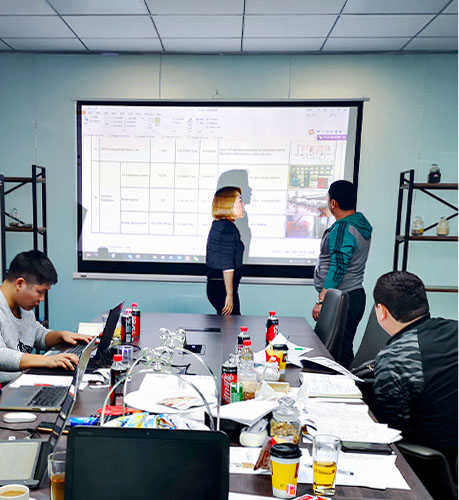
Oman Customer Visit

Oman Customer Visit
In 2024, Omani customers visited our factory to discuss details of the feed pellet production line and sign a contract.
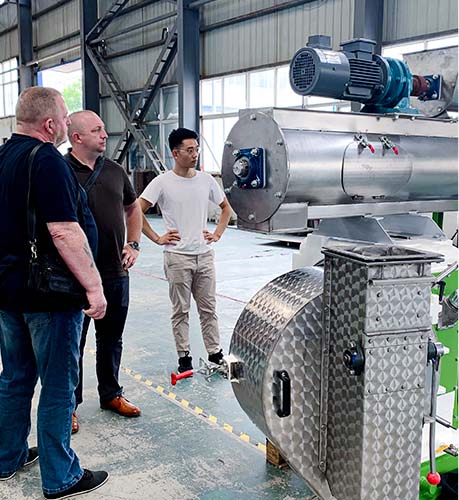
Russian Customer Visit

Russian Customer Visit
In 2023, long-term Russian customer visited our factory to inspect their previously ordered fish feed pellet production line equipment and discuss follow-up matters.
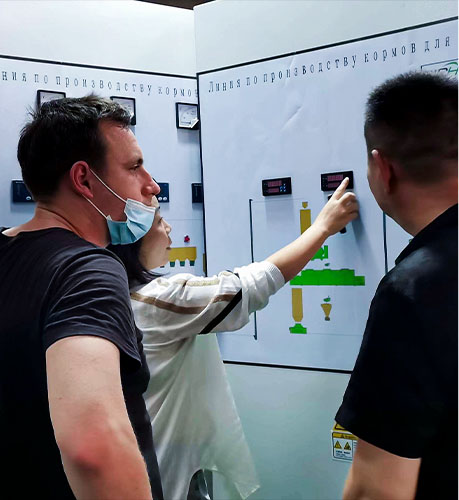
Thai Customer Visit

Thai Customer Visit
In 2022, Thai customers came to our factory to discuss customized details for our aquatic feed pellet production line.
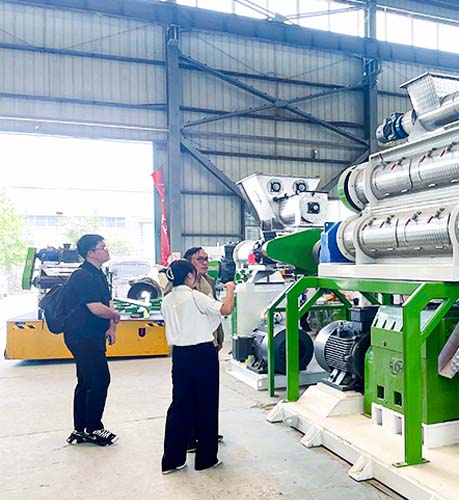
South African Customer Visit

South African Customer Visit
In 2019, South African customers toured our factory equipment and discussed the engineering design for a fish feed pellet production line.