2 T/H fish feed processing plant in Nigeria
Fish Feed Processing Plant (Fully Automated)
Production of feed for tilapia, catfish and moon fish
Feed Specifications:
0.5-8mm
Raw Materials:
Soybean cake, fish meal, cassava flour, peanut cake, internal organs of livestock and poultry, blood, bones and other livestock and poultry breeding wastes…
Production Capacity:
2 tons/hour
NIGERIA AQUACULTURE MARKET

Nigeria is one of the largest economies in Africa and is rich in water resources. The aquaculture industry in this country is experiencing rapid expansion in recent years. Local aquaculture categories include fish, shrimp and other aquatic animals, among which Nile tilapia has become the most popular aquaculture species because of its rapid growth and high market demand.
However, the biggest bottleneck in the development of aquaculture in this country lies in feed.
The fish cultured in Nigeria are mainly edible fish, which need about 400,000 tons of fish feed every year, but more than 95% of them are imported, and the cost of feed accounts for about 80% of the breeding cost. The high price squeezes the profit margin. In addition, due to exchange rate fluctuations and raw material import restrictions, it is difficult for local processing plants to maintain stable production, and the feed made often has problems such as unstable formula, poor particle quality and poor breeding effect.
The processing of extrusion pellet fish feed is a difficult and painful point for Nigerian aquaculture.
Over the years, the Nigerian government has been actively promoting the development of local feed industry, hoping to change this situation through policies and support. This means that Nigeria has an urgent need for localized, large-scale and high-quality fish feed production. For investors in the field of aquatic feed and fish feed production equipment suppliers, this is both a challenge and the best opportunity to enter the local market.
CLIENT PROJECT DETAILS
The project “2 tons/hour fish feed processing plant” was established by a foreign investor in Nigeria. He saw the Nigerian government’s support for foreign investment and thought that Nigeria’s aquaculture industry had huge room for development. Tilapia and catfish are the largest species of farming in Nigeria, and the scale of perch is not small, so he decided to run a fish feed processing factory in the local area to provide high-quality fish feed for farms in the country.
This customer searched and compared many suppliers online. His main concerns are practical: whether fish feed equipment can handle common raw materials in Nigeria (such as soybean cake, cassava flour, peanut cake, etc.) and whether it can produce feed particles with different particle sizes. Because in the local area, tilapia and perch are more suitable for feeding floating feed, while catfish need sinking feed. If a production line can’t give consideration to both floating and sinking feed, it can’t really meet the market demand. After many comparisons, he narrowed down the scope to several international manufacturers.
Then, he spent a lot of time studying the cases of these manufacturers, especially the production projects in Africa and developing countries. RICHI’s project experience in more than 140 countries and the case of fish feed production line in Africa make him feel that our scheme is more valuable for reference. In order to be more at ease, he also specially contacted several local farmers and processing plants to inquire about the word-of-mouth of the equipment.
In several rounds of communication, this customer gradually felt the professionalism and meticulousness of our RICHI team. We not only provide detailed capacity calculation, process flow chart and workshop layout scheme, but also give more reasonable extrusion and drying process suggestions according to Nigeria’s raw materials and climate conditions. For him, this is not simply selling equipment, but someone is considering the feasibility of subsequent operations for him.

Finally, after fully comparing the equipment performance, scheme maturity and after-sales service commitment, he chose to sign a contract with RICHI to hand over the turnkey project of this 2 ton/hour fish feed processing plant to us for production.


CUSTOM-TAILORED SOLUTION
Making expanded fish feed pellets in Nigeria is not only technically difficult, but also difficult for fish feed processing plants to stabilize production. Therefore, when designing the feed production process for investors, our engineers specially considered local resources, market demand, pain points of factory production, and put forward a set of tailor-made plans.
The issues discussed by our engineers and investors are—

Which type of crusher can we choose to find the best balance between efficiency, energy consumption and fineness?
How large is the capacity of the mixer and how long is the batch time set to match the whole line capacity?
How can the drying and cooling process be designed according to the local climate, so that the feed moisture can reach the standard and it is not easy to mildew?
How to screen out the powder and substandard pellets in order to effectively improve the appearance quality of products?
…
The final 2 t/h fish feed production line primarily includes the following parts:
Raw Material Treatment
The soybean cake, cassava powder, viscera, blood, bones and other wastes received by the fish feed factory need to be screened to remove impurities such as stones, hair and bone residue. This can not only protect the subsequent equipment from damage, but also ensure the hygiene and safety of feed.
01
Crushing System
Soybean cake, cassava flour and peanut cake will be reduced by coarse crushing, while fish meal, internal organs of livestock and poultry, blood and bones will be finely crushed to make protein and minerals available evenly.
02
Mixing System
Soybean cake, fish meal, cassava flour, peanut cake and animal waste are mixed according to the formula ratio, and trace vitamins, minerals and fat are added at the same time. In order to ensure the nutritional balance of each feed particle, the system will also carry out secondary mixing to ensure the uniform distribution of trace additives.
03
Extrusion System
Livestock and poultry wastes and plant raw materials are fully expanded in the extrusion process, which not only improves the particle structure, but also plays a part in sterilization and ensures the safety of feed. The cutter will cut the extrudate into the required length, so that the particle density is uniform and the shape is neat.
04
Drying System
The freshly extruded pellets must be sent to the dryer immediately for treatment, so that the water content can be accurately controlled in a safe range, which not only meets the long-term storage demand, but also keeps the complete shape of the pellets.
05
Spraying System
The spraying process mainly depends on the vacuum spraying machine. On the surface of dried fish feed particles, ingredients such as oil, fish oil or flavoring agent are evenly added. It can enhance the fragrance of feed, and also supplement nutrition for feed.
06
Cooling & Screening System
The cooler reduces the temperature of the post-sprayed feed particles to a suitable temperature, which is convenient for packaging and storage. Screening equipment is to select some powder and broken particles before packaging and reprocess them into qualified feed particles.
07
Packaging System
The packaging system is responsible for weighing, packaging and labeling the finished feed. The automatic weighing machine weighs each bag of feed according to the preset specifications, and the automatic packaging machine completes sealing, and marks the production date, batch number and formula information on the package.
08
nigeria FISH FEED PROcessing plant CONFIGURATION
01
Raw Material Treatment
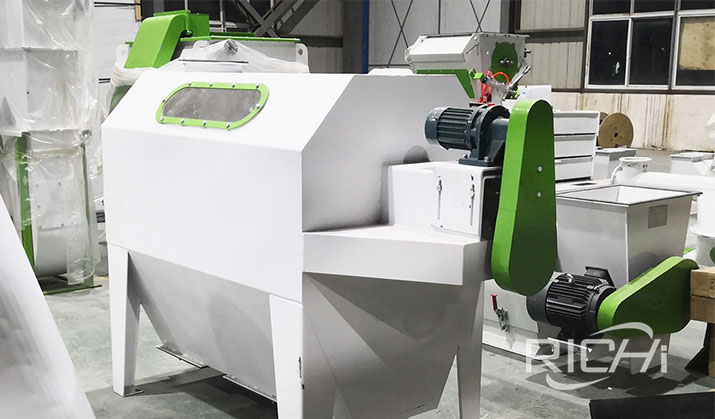
Cylindrical Primary Cleaner
02
Crushing System

Hammer Crusher
03
Mixing System

Single Shaft Paddle Mixer
04
Extrusion System

Wet Type Fish Feed Extruder
05
Drying System

Mesh Belt Dryer
06
Spraying System
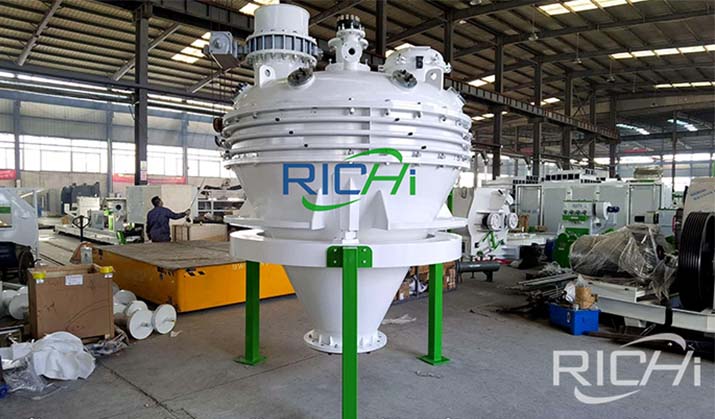
Vaccum Sprayer
07
Cooling & Screening System

Counter-flow Cooler + Sieving Equipment
08
Packaging System

Ton Bag Scale
Complete fish feed processing plant delivery process


Machine Production
Before starting the production of equipment, we have fully investigated the scene of fish feed processing in Nigeria (such as adapting local raw materials and coping with the influence of high temperature on equipment), and then according to these situations, we have made a customized plan for the core equipment such as crusher and extruder.
At the time of formal production, we also paid close attention to the accuracy of key components, fearing that errors would affect the later production capacity and feed quality. In addition, knowing that the local voltage is unstable, we also adjusted the motor and electronic control system.

Equipment Delivery
Considering the weak logistics in some parts of Nigeria, we planned transportation in advance when producing equipment. First, an experienced cross-border logistics team was selected, and those large-scale equipment were also split into modular packages, so that it was not easy to be damaged and it was convenient to assemble in the factory later.
In addition, technical materials (instructions, lists and drawings) in English are also brought in the goods, and we also arrange special personnel to follow up the logistics and explain the location of the goods to customers in real time.




Installation, Commissioning, and Training
After the equipment is delivered to the customer’s factory, we not only help to install it, but also ensure that the whole production line can turn smoothly. Our engineers stared at the installation on the spot, and the parameters of each link were adjusted accurately, and the whole process was tested from the raw materials to the final product.
After we test the process ourselves, we will give practical training to the operation and maintenance workers. This can ensure that the customer team can still confidently operate the whole production line after our engineers leave.
Customer evaluation and project operation status
The boss of Nigeria’s 2-ton-per-hour fish feed processing plant gave us user feedback after the equipment ran for a while:
“Investing in a fish feed factory in Nigeria and choosing RICHI is my most worry-free decision.
We just started to do aquatic feed in Nigeria, and we were particularly nervous when looking for equipment suppliers. After all, the raw materials here are different from those in other places, and the fish need special feed. I am afraid that the wrong equipment will be chosen, and the factory behind it will be full of trouble.
I have seen several suppliers before, and the reason why we finally decided RICHI is that you really understand the Nigerian market! Not only do you clearly know how to optimize the formula to use local common raw materials, but more importantly, your powerful puffing system can flexibly produce floating fish feed and sinking bass feed on one set of equipment. “
“When the whole project was promoted, RICHI’s professionalism really exceeded our expectations. At the beginning, they made process design and planned workshop layout. Instead of just following the general plan, they deliberately considered the actual situation in Nigeria. For example, the weather here is hot and the power is sometimes unstable. We have made adjustments in the plan in advance, giving us not only a bunch of equipment, but a complete plan that can land and produce smoothly. This is particularly true. “

Project Operation
This 2 t/h fish feed processing plant has now run stably for half a year. It consistently achieves its designed capacity without major downtime from faults or process errors. Both floating stability (for floating feed) and water dispersion (for sinking feed) meet quality targets. It reliably supplies feed to local farms raising tilapia, catfish, and bass.
Types of feed suitable for production in NIGERIA
(1)Complete compound feed for poultry
This is the largest and most stable market in Nigeria, and it is easy to realize large-scale and standardized production. Close to Lagos, ibadan, Kano and other consumer markets.
Type
complete feed for broilers, complete feed for laying hens and opening material for chicks
(2)Aquatic Feed
This is a blue ocean market with rapid growth and high profit in Nigeria.
Type
sinking pellet feed (economical) and floating pellet feed (high-end)
(3)ruminant supplement Feeds
This is an essential product for ruminant breeding groups such as cattle, sheep and goats.
Type
cow/beef concentrate, block lick brick
OUR PROJECTS IN OTHER COUNTRIES


2.5 Tons/Hour Fish Feed Production Line In Kyrgyzstan
This project successfully overcame the specific requirements of feed extrusion technology in high-altitude regions, providing a cost-effective, localized feed solution for salmon and trout farming. It can make good use of local common corn and soybean meal, as well as local protein ingredients like flaxseed meal. By precisely controlling conditioning temperature and pelleting parameters, it produces feed pellets for sinking fish such as grass carp and rainbow trout.


3-5 tons/hour fish feed factory in Kazakhstan
Designed by RICHI, this 3–5 tons/hour fish feed production line features a twin-screw extruder and multiple grading screens. The biggest highlight is that the production capacity can be flexibly switched according to the market demand—running at full capacity of 5 tons/hour during peak season and dropping to 3 tons/hour during off-season. This not only saves energy but also reduces costs. This line can produce feed for both coldwater and freshwater fish.


1-2 tons/hour fish feed processing plant in Azerbaijan
Tailored to the aquaculture demands along the Caspian Sea, this production line allows for easy switching between sturgeon feed and conventional fish feed. Considering the high sand content of some raw materials in Azerbaijan, we’ve also added an impurity removal device to the line, significantly reducing wear and and enhancing machinery durability.


RICHI Guarantee
In the field of aquatic feed pelletizing equipment and full aquatic feed pellet production lines, we leverage our team’s extensive experience to accurately understand your process engineering needs, deeply solve practical challenges, and tailor-made reliable solutions that meet international high standards for you.

Custom Design

Extensive Experience

Professional Service Team

Competitive Advantage
WHAT FEED PROCESSING SOLUTIONS CAN WE PROVIDE?
Fish, shrimp, crab, shellfish and other conventional aquaculture species and special aquatic animals

Cats, dogs, hamsters, turtles…

Poultry & Livestock feed production line
Chicken, duck, goose, pigeon, pig…

ruminant feed production line
Cattle, sheep, horses, deer, camels…

Multi-functional feed production line
Flexible switching between multiple categories